
Capturing the Essence of Place: Sketching on Location (Part Two)

Following on from last month’s post about the equipment I used for sketching on location, I’m turning to something less tangible but just as important: how I find inspiration when I’m out sketching, and how I make the most of what’s in front of me. I'm sharing this give some insight into how I gather ideas for my paintings, but also, to dispel any hesitation you may have to try it for yourself.

Even at school I was always drawn to landscapes and animals, and my love for that hasn’t changed. Back then I couldn’t have explained why I wanted to draw certain things, but now, as an adult and a practicing artist, I can better write about my connection to the landscape, and what it is that inspires me to capture it.
So what is it that catches my eye enough to make me what to sketch it? Fundamentally, it comes down to four key elements: light, colour, shapes, and mood.
For a scene to feel worth sketching, I find a place where three elements, light, colour and shapes, come together in a way that invites me to spend some time with it. A scene doesn’t have to be a grand, sweeping view to be appealing. It might be a narrow path disappearing into trees, birds sitting on a fence, heather in bloom, or a shoreline dotted with wading birds.

Whatever the subject, it’s that search for the right combination that draws me in. Just as importantly, I try to remember that sketching is really a way of collecting ideas and there’s a lot of joy in simply sitting and drawing.
Colour
Being a landscape artist, I’m always looking out for scenes that catch my eye, and quite often it is colour and shapes. Just a few days ago I drove past a field of phacelia (purple tansy, a common crop here in Suffolk) with a riot of wild red poppies in the same field. I just to stop and take a photo!
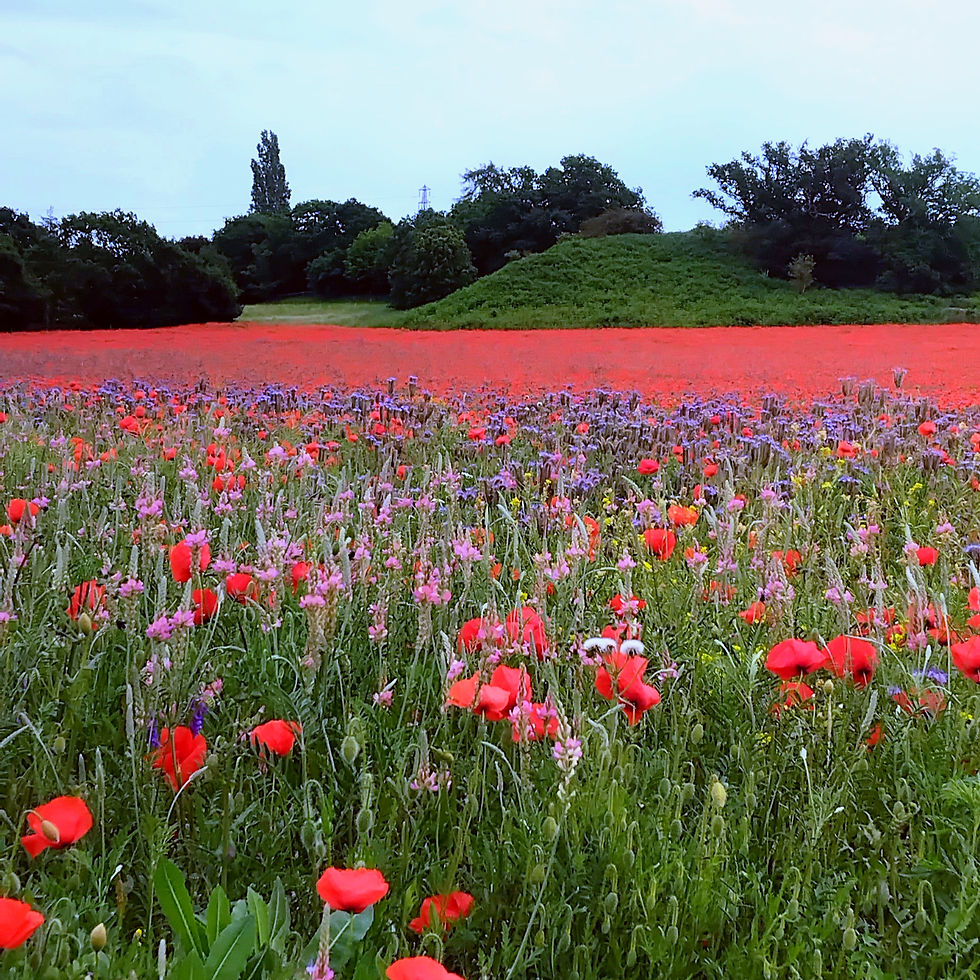
There’s another spot along a route I frequent that I’ve been meaning to return to with my sketching kit. From the road the fields drop away into a gentle dip and rise again, creating beautiful curves and lines. Ancient hedgerows and trees frame the edges, and it’s especially beautiful in spring with so many shades of green, and again in late summer with golden crops and bleached out grasses. I just need to find a footpath or a set of tractor lines running through it to perfect it!

Many years ago, I spent a summer sketching on location at a living museum set around a tide mill, and it was the perfect place to return to again and again. There was endless inspiration: the mill itself, the views from the upper floors, the estuary wildlife, the mudflats when the tide was out, the shifting water when it came back in, and sailing boats passing through and resident boats moored nearby.
Viewfinder
Finding a place like that is a wonderful for inspiration, but it is too easy to feel overwhelmed by everything in view. I use a viewfinder to help me crop the scene and focus on the part that holds the best composition. By scanning the scene, I can block out distractions like an unwanted object, a stray figure, or anything else that is distracting. It’s the same idea as cropping a photograph: refining the view until what’s left is a strong composition. The one I use is small enough to slip into my sketch bag, and it adjusts easily between a square and a rectangle.

Once I’ve settled on a view I like, I take a quick photo on my phone for reference. I find the easiest way to use the viewfinder is with my arm outstretched and my head tilted slightly towards it. I learned this technique when studying Still Life, and it is a good way to find the view again easily.
Light
The way light plays across a scene can make all the difference. It creates contrast, draws the eye, and often turns an ordinary view into something that feels exciting to sketch. Bright sunshine can spotlight certain areas and deepen shadows, but dramatic clouds in wet weather can be just as compelling.

The direction of the light matters too. It helps define forms and emphasises the relationship between light and shade. I often use a side lit position as it highlights the structure and character of the trees that appear so often in my work. Backlighting can be particularly beautiful, catching seed heads and feathers with a soft glow, while low evening light can simplify shapes into striking silhouettes. That low evening light is known as the golden hour, roughly the hour after sunrise and the hour before sunset. The light becomes softer and warmer, with a golden glow, and the long shadows add depth and drama to the scene.
Shapes

Because the light changes so quickly, I always start with a small black-and-white thumbnail sketch as well as the photo on my phone. These quick pencil notes help me remember where the main areas of light and shadow are. I’ll also jot down any cloud shapes, as they can shift and vanish in moments.
I only spend a few minutes on a thumbnail sketch, and it is a good way to test that the composition works. It’s a chance to consider how the shapes relate to one another, and whether they’re arranged in a pleasing way.
Mood
Mood, or atmosphere, is the result of everything coming together to express the narrative of the scene. It’s that sense of storytelling that gives a sketch its meaning. For example, a Scottish croft set against a vast mountain can evoke awe, and adding a thin thread of smoke from the chimney hints at warmth, comfort, and shelter from the elements.

In my studio work, based on my sketches, my aim is to create a sense of calm and tranquillity. I’m inspired by the nature of landscapes and wildlife. Colour is one of the most important tools I use to convey mood and atmosphere. But when I’m sketching on location, my focus is simply on capturing what’s there, knowing I can experiment and develop the idea further later on. I’ll often add a few notes too, to help me remember how the place felt in that moment.

Once I have chosen my view, I begin with a loose sketch of the composition and start applying watercolour. What matters most at this point is that I interpret the scene in my own artistic voice. I may simplify the scene by leaving objects out, or moving something. Sometimes, having drawn a few thumbnails, I may need to reposition myself to get the best view. I also choose the colours that will work for the scene. A good understanding of how the paints mix together in my own watercolour box helps, and I'm always keen to not use too many at once. Landscapes tend to have their own harmonious colour combinations, so a sensitive approach to the tones I see helps to capture the right feel. I also capture detail with an ink drawing pen where needed.
A sketchbook can hold all sorts of information, and a single session might include thumbnail compositions, a colour sketch, written observations, and a few small studies that focus on particular details.
At its heart, sketching on location should feel enjoyable, and I’ve found a way of working that suits me. There’s plenty of advice out there on how to begin, but with practice an artist starts to develop their own rhythm and a natural flow in how they approach it. It took me time to reach that point, but now I can arrive at a place, open my sketch bag, relax, and simply take in what’s around me. I’m not only focused on the end result, because being there, sitting quietly and absorbing the atmosphere, often matters more than having something finished to show for it.
Thank you for joining me for this months behind the scenes blog. If you wish to share your thoughts, please comment below.
Back next month, when I begin my A-Z of landscape painting!
Deborah x


What a lovely post to read and I enjoyed the various sketches, photos and paintings very much too.