
Unlocking Potential: How Sketchbooks Fuel Artistic Growth and Creativity

Artists use sketchbooks for many reasons. They usually have several on the go, stick all sorts of things they collect in them, as well as sketch, paint and doodle on the pages. This makes them delightfully colourful, messy, and crammed with ideas and collected treasures. Some of mine over the years have had to be reinforced with duct tape to keep the spines together!
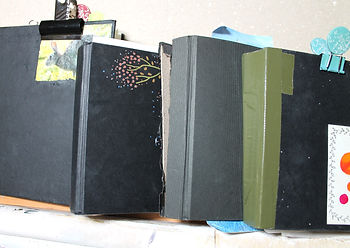
I have sketchbooks with different types of paper pages too. This helps when I go out on location as I may want to capture scenes on watercolour paper or go sketching with kraft paper and use only pen or pencil with black and white conte crayons. On the whole my sketchbooks fall into two categories: the ones that I use for sketching on location and the ones I reserve as my main studio sketchbook for planning and development of ideas. Quite often I take the successful sketches on location and paste them into the studio sketchbook so I can study them a bit further. I collect ideas for paintings this way, and develop the composition, tone and colour palette with handwritten notes. The studio sketchbook is usually a square Seawhite hardback that has plenty of room for my ideas. Using a square book is conducive to my ideas as they are mostly translated onto square cradled boards for painting.
In this blog I will share with you the studio sketchbook I use to collect ideas, and work out compositions, titles and colour in preparation for a test painting, then final painting.

I keep all of my sketchbooks and I find it useful, like now as I'm writing this, to have a look back over the years. I can see improvements in my thoughts and outcomes, and the collection acts as a document of my career progress. There are some pages that make me cringe, (which is why most artists keep their sketchbooks private!!), so I won't share those pages with you, but I can share some of my creative journey as I look back at how some of them became successful paintings.


I also find in past sketchbooks some ideas that I haven't made into final paintings yet. These sketches are from working on location that I have pasted into the studio sketchbook, and I will develop these into paintings at some point.


Sometimes I work in series, and not necessarily in the same period of time. Keeping a record of my ideas for a series in my sketchbook helps the group of paintings stay in the same vein. When I started out as an working artist, I didn't do that very well, and it is something I have learned to do along the way. As I generally only work up to VII (seven) paintings in a series, I will also try to keep them all in the same book. Some artists work their series differently. Some work on all of them at the same time, or within a period with no other works in progress, and some keep working on a theme with numbers up into the twenties and beyond. It is all a matter of choice and inspiration. For me, it is about keeping things fresh and limited.
The most recent series I have been working on since 2020 is, 'The Heartbeats Underground'. My intention is to complete it this year. I have two more to do, (VI and VII), and I will be sorry to finish it to be honest. I have loved working on this series, which is why I have taken my time with it.
I have another studio sketchbook that I dedicated to a particular period of experimentation. This is a collection of test paintings experimenting with knife painting which kept the studies loose. I used photographs I had taken while out on location in Spain and on walks in Suffolk. They reflect a particular time when I was experimenting with ways to paint quickly with acrylics on location, working in layers and adding marks with Caran D'ache water soluble crayons.


I mentioned how I will jot down notes with my ideas. It is through these thoughts and general notes that I generate titles for paintings. There are times when a title just won't come until the work is complete, but over the last few years I have found that the development work done in the sketchbook will trigger ideas for titles. As I work on the specifics of the work and tease out colours and details, I will get a sense for the feel of the scene and I will note words that describe it. Sometimes the title will be obvious and specific, sometimes a bit vague or, with a series like 'The Heartbeats Underground', it will have a layered meaning. (I talk about this in more detail in this blog post).
Some titles can be open to interpretation, for example, my series 'Where We Walked', was a selection of different locations and seasons, so it was left to the viewer to make sense of the scene for themselves and see if they relate to it in any way.

Final titles come at various stages. Sometimes I know (when working in series), but often they come as I'm working on it, but sometimes not until it is complete. If a title doesn't come with a painting I will have to 'sit' with it for a while and let it reveal to me what it is conveying. That will involve propping it up somewhere in the house where I see it everyday for a couple of weeks. When working from one of my own photographs, I can usually remember the day and feeling I had when I took it, but paintings do sometimes take on their own personality as they are developing. This can mean the final painting evokes something different to what I was sensing on the day I took the photograph.

As I work through my studio sketchbooks, it is apparent that not all ideas end up as final paintings. But they do all have common landscape and nature themes that convey tranquility, peace and calm in all seasons. Mostly my titles will reflect this, and I have whole pages devoted to collecting words that describe my inspirations in my current studio sketchbook. The titles of paintings is an interesting subject because it is a crucial element of the personal expression of the artist. They help to convey a sense of the painting to the viewer and provides a glimpse into the artist's thought processes. A title can inspire intrigue and mystery, or it can describe its character or a story. Whether the title is descriptive or ambiguous, it remains an important aspect, and even if the title is really obscure, it will tell you something.
To conclude, the sketchbook is the workhorse of the artistic process, and creates a journal in which the artist develops their ideas and inspirations. In reality it is a far cry from the pretty and inspiring sketchbooks entries you sometimes see in social media, or at open studios (artists will never show you anything they don't want you to see), but it is where all the good and bad sketching days reside, warts and all. I remember studying art for school at the age of 16, and it being drummed into us that we must show all of our prep and workings for the final piece for assessment, and I can remember thinking, how boring and irritating. But as I progressed through my own studies as an adult, I realised that the prep is where the magic happens, and I would never be without my sketchbook now.

Thank you for joining me on my latest blog, as always, feel free to share how the sketchbook works for you, or just leave a comment to say hello!
Back next month with more creative insights.
Debs x

Very interesting as usual.
Dad xxx